Most "how to get backlinks" guides list forty tactics and give each one a paragraph. That is not how a link building budget works. You usually have a few hours a week and a limited budget, so the useful question is which three or four methods fit your site right now. We ranked the methods by how often they produce a link that a reader might actually click, then added effort and cost so you can choose.
Short version
- Start with links you are already owed: unlinked brand mentions, partners, suppliers and directories that matter in your industry.
- Build one asset worth citing (original data, a calculator, a template), then promote it with outreach.
- Use guest posts and paid placements selectively, on relevant sites, with disclosed links and natural anchors.
- Avoid automated link schemes, private blog networks and keyword-stuffed anchors. Google's spam policies name all of them.
What counts as a good backlink in 2026?
A backlink is a link from another website to yours. Search engines still use links to discover pages and to judge how much other sites trust them, but not every link counts the same. A link helps most when it comes from a page about a related subject, sits inside the main content, is placed because an editor chose it, and sends at least some real visitors.
Metrics such as Ahrefs Domain Rating (DR) are useful for comparing a shortlist. They do not tell you whether a site is relevant or whether its traffic is real. We wrote a separate checklist for that: how to vet a site before you ask it for a link.
What people search for when they research link building
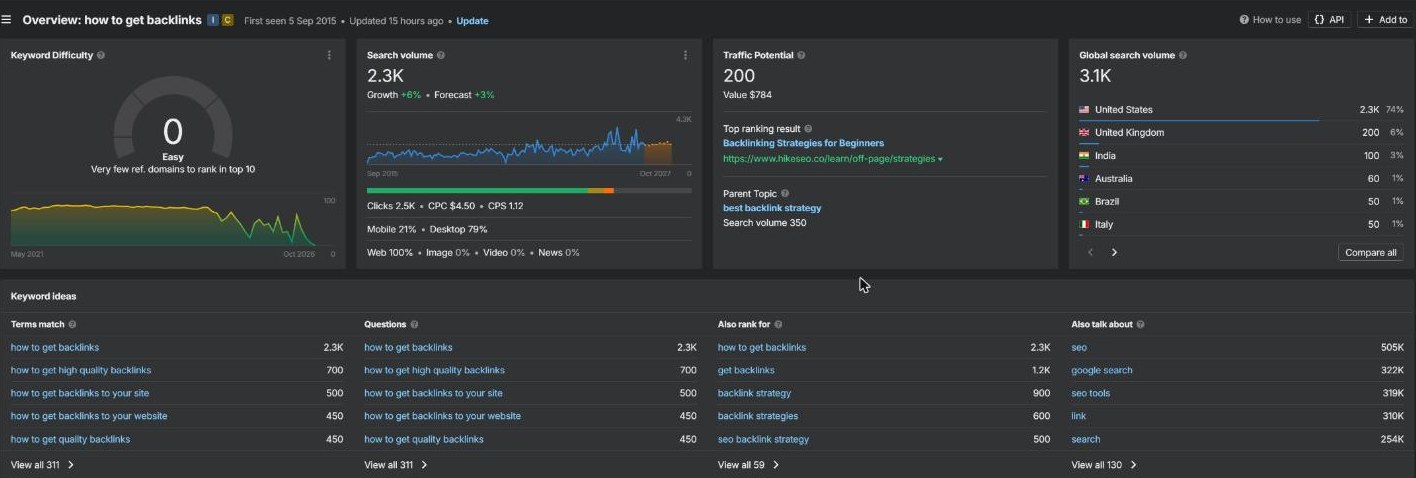
Before writing this guide we pulled US search data from Ahrefs Keywords Explorer (October 2026). The main query, "how to get backlinks", gets about 2,300 searches a month in the US and around 3,100 worldwide. Ahrefs rates its Keyword Difficulty at 0, which tells you something about the pages currently ranking: few of them have strong links of their own.
The tactic-level searches show which methods people are trying. Guest posting and expert sourcing (the old HARO model) still lead, followed by broken link building and local link building.
Source: Ahrefs Keywords Explorer, October 2026.
Show the data
| Value | |
|---|---|
| guest posting | 1,300 |
| haro link building | 1,200 |
| broken link building | 1,100 |
| local link building | 1,000 |
| link building outreach | 700 |
| resource page link building | 700 |
| pr link building | 600 |
What are the best ways to get backlinks? The 12 methods at a glance
| Method | Effort | Typical cost | Risk | Best for |
|---|---|---|---|---|
| 1. Reclaim unlinked brand mentions | Low | Time only | Low | Brands that already get press or reviews |
| 2. Partner, supplier and customer links | Low | Time only | Low | B2B, SaaS, local businesses |
| 3. Publish original data | High | $500 to $5,000+ in research and design | Low | Sites with access to first-party data |
| 4. Free tools, calculators and templates | Medium to high | Development time | Low | SaaS, finance, marketing |
| 5. Expert sourcing for journalists | Medium | Free to paid platform plans | Low | Founders and specialists with real expertise |
| 6. Guest posting on relevant sites | Medium | Writing time, sometimes a publisher fee | Medium if done at scale | Most niches |
| 7. Broken link building | Medium | Time and an SEO tool | Low | Sites with strong evergreen content |
| 8. Resource page links | Low to medium | Time only | Low | Education, health, local, nonprofit-adjacent |
| 9. Competitor backlink gap | Medium | SEO tool subscription | Low | Any site with clear competitors |
| 10. Digital PR and data stories | High | $5,000+ per campaign at agencies | Low | Brands with a news angle |
| 11. Podcasts, interviews and roundups | Low to medium | Time only | Low | Founders, consultants, authors |
| 12. Disclosed paid placements | Low | Publisher fee | Medium, depends on site and anchors | Speed, new markets, launches |
Costs are planning ranges, not quotes. Agency digital PR pricing comes from BuzzStream's 2026 pricing review; publisher fees vary by site.
1. Reclaim unlinked brand mentions
If people already write about your company, product or founder, some of those articles will mention you without a link. These are the easiest links you will ever get, because the author has already decided you are worth mentioning.
- Search Google for your brand name in quotes and exclude your own site:
"YourBrand" -site:yourbrand.com. - Set up mention alerts in Ahrefs (Alerts → Mentions), Google Alerts or a similar tool so new mentions reach you weekly.
- Check each page for an existing link. If there is none, email the author or editor, thank them, and point to the exact page that would help their readers.
Keep the request short. Editors are more likely to add a link when you make it easy: name the article, quote the sentence and give the URL.
2. Ask partners, suppliers and customers
Companies you work with often have "partners", "integrations", "where to buy" or "case studies" pages. A link from those pages is relevant by definition. Make a list of every software integration, reseller, supplier, agency and association you are connected to, then check which of them already list partners and whether you are on the list.
This method is limited by how many real relationships you have, but it rarely fails. Do not turn it into a link exchange program: Google's spam policies specifically mention excessive link exchanges and partner pages built only for cross-linking.
3. Publish original data people want to cite
Writers need numbers. If you publish a statistic nobody else has, other articles will link to you as the source for years. The data does not have to be a large survey. Pricing data from your own platform, anonymized usage numbers, a public dataset you cleaned up, or a small benchmark you ran can all work.
An example from our own work: when we analyzed the 4,912 publishers listed in the LinksFlow catalog, the correlation between a site's Domain Rating and its guest post price was weak (0.26). That kind of finding is easy to quote and hard to get anywhere else. We published it in our link building pricing guide.
To make a data page linkable:
- Put the main findings at the top as short, quotable sentences.
- Show the method: sample size, date range, how you collected it.
- Add charts people can embed or screenshot, with your site name on them.
- Update it once a year and keep the same URL, so links keep building on one page.
4. Build a free tool, calculator or template
A useful free tool earns links from blog posts, resource lists and forums for as long as it works. It can be small: a cost calculator, a checklist in Google Sheets, a template, a converter. Ahrefs' own backlink checker is the extreme example, with keyword variations of "backlink checker" adding up to well over a million US searches a month.
The trap is building something nobody searches for. Check keyword demand first, look at what already ranks, and build a version that is faster, simpler or more accurate.
5. Answer journalist requests as an expert
Reporters and bloggers ask for expert quotes every day. If your answer is used, the article often links to your site. HARO (later renamed Connectively) was the best-known platform for this until it shut down on December 9, 2024. The same model now runs on services such as Qwoted, Featured and Help a B2B Writer, and on social media through hashtags like #journorequest.
"haro link building" still gets about 1,200 US searches a month, so plenty of people are looking for the replacement. What works on these platforms:
- Reply only where you have real experience. Editors reject generic answers fast.
- Answer the exact question in the first two sentences, then add one specific detail or number.
- Reply quickly. Many requests are filled within hours.
- Include your name, title, company and a one-line bio the writer can paste.
6. Write guest posts for relevant publications
A guest post is an article you write for another site's audience. Done well, it brings referral traffic, puts your name in front of a relevant audience and earns a contextual link. Done badly (the same thin article placed on dozens of unrelated sites with an exact-match anchor) it is exactly what Google's link spam policy describes.
The rules we follow:
- Pick sites whose readers could become your customers. Relevance beats metrics.
- Write something the publisher would be happy to publish even without a link.
- Link where it helps the reader, usually to a guide or resource, with a natural anchor such as your brand name or a descriptive phrase.
- If you pay for the placement, the link should be marked
rel="sponsored"ornofollow, as Google's guidance on outbound links recommends.
Our full process is in guest posting for SEO in 2026.
7. Broken link building
Pages on the web die all the time, and the links pointing to them stay behind. Broken link building means finding those dead links on relevant sites and offering your page as a replacement. It works because you are fixing a problem for the site owner, not just asking for a favor.
- In Ahrefs Site Explorer, enter a competitor or an industry site and open the "Broken backlinks" or "Best by links" report filtered to 404 pages.
- Look for dead pages that had many referring domains and covered a subject you also cover.
- Check that your replacement page is a close match. If it is not, improve it first.
- Email the sites linking to the dead page, tell them where the broken link is, and offer your page as one option.
8. Get listed on resource pages
Many sites keep curated lists of useful links: "resources for new founders", "accessibility tools", "local services for seniors". Search for them with queries like "your topic" + intitle:resources or "your topic" + inurl:links. Resource pages convert well when your page is genuinely free and useful, so they suit guides, tools and templates better than product pages.
9. Copy what already works for competitors
A backlink gap analysis shows sites that link to two or three of your competitors but not to you. Those sites have already shown they link to businesses like yours. In Ahrefs this is the Link Intersect tool; Semrush calls it Backlink Gap.
Sort the results by relevance first, not by DR. A trade association linking to three competitors is a better target than a high-DR news site that mentioned one of them once.
10. Run a digital PR campaign
Digital PR means creating a story journalists want to cover (survey results, a data study, an expert reaction to news) and pitching it to them. It can produce links from major publications, but it is expensive and uneven. BuzzStream's 2026 pricing review puts agency digital PR at roughly $5,000 to $10,000 per campaign, or about $1,250 to $1,500 per link.
For a small team, a lighter version works: react to industry news within a day with a short expert comment and one data point, and send it to the reporters who cover that beat.
11. Go on podcasts and join expert roundups
Podcast hosts need guests every week, and most episode pages link to the guest's site. Pitch shows your customers listen to, suggest two or three specific topics, and mention one thing you can say that their past guests have not. Expert roundups work the same way at a smaller scale.
12. Use disclosed paid placements, carefully
Many publishers sell sponsored articles. Paying for a placement is not against Google's rules by itself; passing ranking credit through a paid link is. Google's spam policies list "exchanging money for links, or posts that contain links" as link spam and recommend marking paid links with rel="sponsored" or rel="nofollow".
So treat paid placements as distribution: a way to reach a new audience, test a market or support a launch on sites with real readers. Choose publishers by audience and editorial quality, keep anchors natural, and do not expect a guaranteed ranking change. If you use a marketplace, compare publisher fees with service fees separately. Our publisher catalog shows publisher prices and the $30 coordination fee as separate lines for that reason.
A simple 30-day backlink plan
| Week | Focus | Output |
|---|---|---|
| 1 | Reclaim mentions, contact partners and suppliers, list competitor gap sites | A prospect sheet with 50 to 100 relevant sites and a stop list |
| 2 | Pick or build one linkable asset (data page, template or tool) | One page worth citing, with quotable findings at the top |
| 3 | Outreach: broken links, resource pages, guest post pitches, expert requests | First wave of personalized emails plus one follow-up each |
| 4 | Follow up, publish accepted guest posts, record live URLs | A log of live links with dates, anchors and link attributes |
Expect a low reply rate at first. In Backlinko's study of 12 million outreach emails, only 8.5% received any reply, and a single follow-up raised replies by about 66%. Our link building outreach guide covers templates and follow-up timing.
What to avoid
- Automated link building tools that post to forums, comments or directories in bulk. Google's policies name "automated programs or services to create links" as link spam.
- Private blog networks and sites that sell links to anyone in any niche.
- Exact-match commercial anchors repeated across many guest posts.
- Sitewide footer or template links on other sites.
- Buying links that pass ranking credit without disclosure.
Google ran three spam updates in 2026 (March 24, June 24 and August 18) and a core update starting May 21. Google said the August update did not target link spam, which it handles with separate systems. Those systems tend to ignore manipulative links rather than penalize the whole site, so the main cost of bad links is wasted money.
Frequently asked questions
How many backlinks do I need to rank?
There is no fixed number. Look at the pages ranking for your target keyword in Ahrefs or Semrush and count their referring domains. For "how to get backlinks" itself, Ahrefs estimates you need very few referring domains to reach the top 10, while competitive commercial terms can require hundreds.
How long do backlinks take to work?
Google has to recrawl the linking page before a new link is counted, which can take days to weeks. Ranking changes from link building are usually visible over months, not days, and depend on how competitive the query is.
Can I get backlinks for free?
Yes. Methods 1, 2, 5, 7, 8, 9 and 11 cost only time. Free does not mean fast, though, and most teams combine free methods with some paid content or placements.
Are paid backlinks allowed?
Paid placements are allowed if the link is qualified with rel="sponsored" or nofollow. Paying for links that pass ranking credit violates Google's spam policies.
What is the best backlink strategy for a new website?
Start with the links you are owed (partners, suppliers, mentions, relevant directories), publish one asset worth citing, then add guest posts on closely related sites. That mix builds a natural-looking profile from the start.
Need relevant publishers without the research? Browse the LinksFlow catalog to compare publishers by topic, language, audience country and price, or send us a managed outreach brief. We do not promise rankings; we help you find relevant sites and keep the terms clear.
Sources
- Ahrefs Keywords Explorer, US database, keyword data retrieved October 23, 2026.
- Google Search Central, Spam policies for Google web search.
- BuzzStream, Link Building Pricing (updated October 2026).
- Backlinko and Pitchbox, email outreach study (12 million emails).
- Zapier, HARO alternatives (Connectively shutdown date).
- PPC Land and Relevant Audience coverage of the 2026 Google spam updates.
- LinksFlow catalog snapshot, 4,912 publishers, October 24, 2026.
Related guides
- Guest posting for SEO in 2026: what still works and what Google ignores
- Link building outreach: a workflow, email templates and reply-rate benchmarks
- How to vet guest post sites: 12 checks for high-quality backlinks
- Link prospecting: how to build a clean outreach list and a stop list that prevents duplicates
- Link building pricing in 2026: what guest posts actually cost and how to budget
 UA
 US
 IT
 BR
 EG
 IN
 ID
 NG
 ES
 RU
 CZ